Leucospermum bolusii Gand.
Gordon's Bay pincushion · witluisiesbos (Afr.)
Dedicated to Amy, with real love.
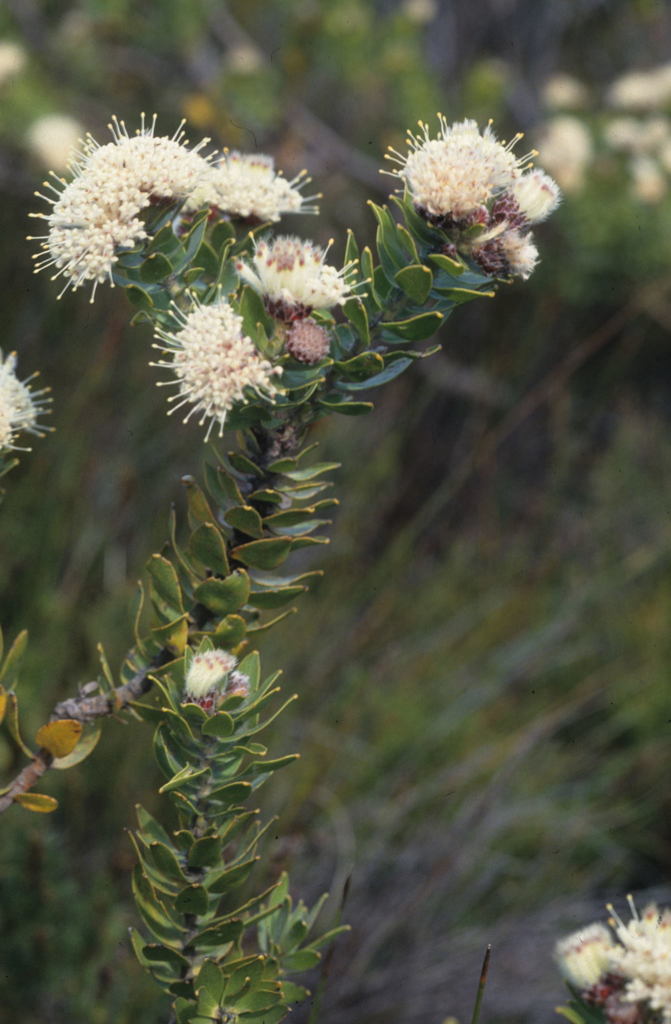
A rare pincushion that breaks the rules: instead of bright orange or yellow, its small heads are cream-white, and they carry a sweet perfume that hangs in the air on still evenings. Easy for a protea, and lovely in a vase.
What’s in the name: Leucospermum: from Greek leukos, "white", and sperma, "seed", after the pale seeds found in many species; bolusii: honours Harry Bolus (1834–1911), the South African botanist who founded the Bolus Herbarium in Cape Town.
“Full many a flower is born to blush unseen, And waste its sweetness on the desert air.”
— Thomas Gray, Elegy Written in a Country Churchyard – Palgrave, The Golden Treasury (1861), Project Gutenberg
Not currently on our availability list.
Family
Proteaceae
Conservation status
Near Threatened (as given by SANBI PlantZAfrica): a localised endemic under pressure from fires that come too often, invasive alien plants and housing development
Natural distribution & habitat
Endemic to a tiny patch of the Hottentots Holland coast: the rocky sandstone mountainsides facing west over False Bay, above the coastal road from Gordon's Bay to Kogel Bay (hence the English name).
Size & form
Neat, dome-shaped evergreen shrub reaching roughly 1.5 m. Leaves are short, grey-green and softly hairy while young, each tipped with a single small tooth.
Flowering
September to December, at its best from late October into early November. Each flat, button-like head is only about 2 cm wide and packs 50 to 100 tiny tubular florets, cream-white (Afrikaans wit, 'white'); the buds sit in pinkish-red bracts. Seeds ripen and fall roughly two months later.
Uses in landscaping
- Scented shrub for a patio, path or evening garden
- Cut flowers: long-lasting, fragrant stems
- Fynbos and waterwise plantings on acid, sandy soil
- Pollinator garden
Care notes
Plant in full sun in very free-draining, acidic, sandy soil; on clay or anywhere that stays wet, roots fall prey to Phytophthora rot, so use a raised bed or a large pot with a sandy acid mix. Avoid rich soil and strong fertilisers high in nitrogen or phosphate. A yearly mulch of well-rotted compost (autumn, spring, or both) is all it needs. Sow seed from March to May: no smoke treatment is required, as the swing between warm autumn days and cold nights triggers germination, and seedlings can be potted on after three or four months. Semi-hardwood tip or heel cuttings taken from late summer into autumn root under mist with bottom heat and a rooting hormone.
Wildlife value
Bees, wasps, flies, butterflies and moths visit the flowers. Ants carry the seeds (whose pale, tick-like look gives the Afrikaans luisies, 'little ticks') underground for their fleshy coat, keeping them safe until they sprout. Fire kills the adult plants; the species comes back from that buried seed.
Find out more
Facts checked against: SANBI PlantZAfrica species page 'Leucospermum bolusii'; iNaturalist observation records.