
Cissampelos capensis L.f.
Cape moonseed vine · dawidjies, davidjes (Afr.)
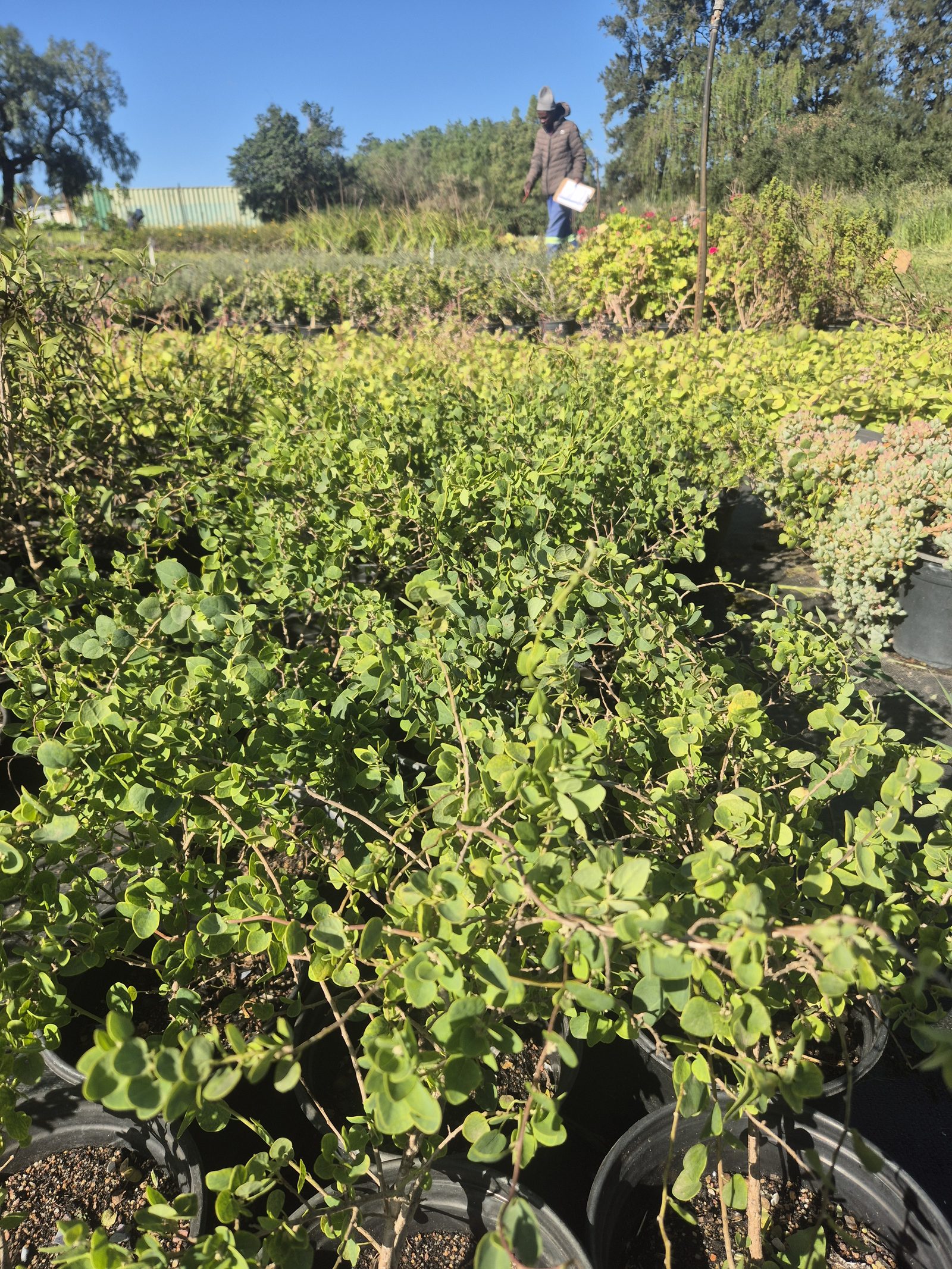
Slow, tough scrambling shrublet with blue-green leaves; a long-used medicinal plant for dry, windy spots.
What’s in the name: Cissampelos: Greek "ivy" + "vine", for its climbing habit; capensis: "from the Cape".
“the leaf thereof for medicine”
— Ezekiel 47:12 (KJV), The King James Version of the Bible (Project Gutenberg)
Available from AVNPlants: see the availability list.
Family
Menispermaceae
Conservation status
Least Concern, SANBI Red List of South African Plants
Natural distribution & habitat
Western and southern parts of the country, western Karoo to Gqeberha, and southern Namibia. Open sandy slopes and scrub on well-drained sandy or granite soils, up to about 1 900 m.
Size & form
Twining or sprawling shrublet to about 1 m, with small rounded to heart-shaped leaves (to 25 mm). Male and female flowers on separate plants.
Flowering
February to May: tiny greenish-yellow flowers.
Uses in landscaping
- Sunny, dry, windy corners
- An excellent waterwise climber for covering fences (in our experience)
- Combine with other dry-garden plants such as sour figs and Salvia aurea
Care notes
Sandy, well-drained soil with compost. Grow from seed: soak ripe orange seed in lukewarm water for 12–48 hours and sow about 1 cm deep in autumn in a sandy, bark-based mix.
Wildlife value
Probably bee-pollinated; the orange berries may be spread by birds or baboons.
Traditional & cultural uses
Why "dawidjies"? The name is short for dawidjieswortel, first recorded by Thunberg around 1772. It literally means "David's root", but where it comes from is uncertain. One suggestion is a Biblical reference, though even that is just a guess. The same name is also used for several other plants that are used in a similar way.
Cape and Khoi-San medicine: dawidjies is one of the plants recorded in reviews of Khoi-San and Cape Dutch plant medicine. The root was soaked in wine or brandy, or boiled, and taken as a blood purifier, an emetic and purgative, and for complaints such as boils, skin problems, diarrhoea and syphilis. Botanists describe it as being of special significance in Khoi-San medicine. A paste of the leaves was put on sores and snakebites. The plant is almost certainly toxic, and the leaves are known to poison cattle.
Rastafari bush doctors: in the Western Cape, Rastafari bush doctors know dawidjies well. They gather the woody stems and sell them at local markets. Research on these healers lists it among their medicinal plants and describes how they see their work as reviving Khoi-San healing traditions.
Spiritual and protective uses: the stems are burnt as incense to keep evil spirits away, and an infusion of the stems is used as a ritual wash for the same purpose. Pieces of root are often worn around the neck, arms or waist as protective charms.
Shared for interest only, not as medical advice. Dawidjies is toxic, so please don't use it as medicine without guidance from a qualified practitioner.
Find out more
Facts checked against: SANBI PlantZAfrica species page 'Cissampelos capensis'; SANBI Red List of South African Plants, Cissampelos capensis L.f. (assessment 2005/06/30); Van Wyk, B.-E. 2008. A review of Khoi-San and Cape Dutch medical ethnobotany. Journal of Ethnopharmacology 119: 331–341 (doi:10.1016/j.jep.2008.07.021); Philander, L.A. 2011. An ethnobotany of Western Cape Rasta bush medicine. Journal of Ethnopharmacology 138(2): 578–594 (doi:10.1016/j.jep.2011.10.004); Aston Philander, L.E. 2010. An Emergent Ethnomedicine: Rastafari Bush Doctors in the Western Cape, South Africa. PhD dissertation, University of Arizona; Smith, C.A. 1966. Common names of South African plants (as cited by PlantZAfrica); De Wet, H., Van Heerden, F.R. & Van Wyk, B.-E. 2011. Alkaloidal variation in Cissampelos capensis (Menispermaceae). Molecules 16(4): 3001–3009 (doi:10.3390/molecules16043001). Further reading (book not consulted directly): Van Wyk, B.-E. & Gericke, N. 2000. People's Plants: A Guide to Useful Plants of Southern Africa. Briza Publications, Pretoria (ISBN 9781875093199).