
Carpobrotus edulis (L.) L.Bolus
sour fig, Cape fig · ghaukum, ghoenavy (Afr.)
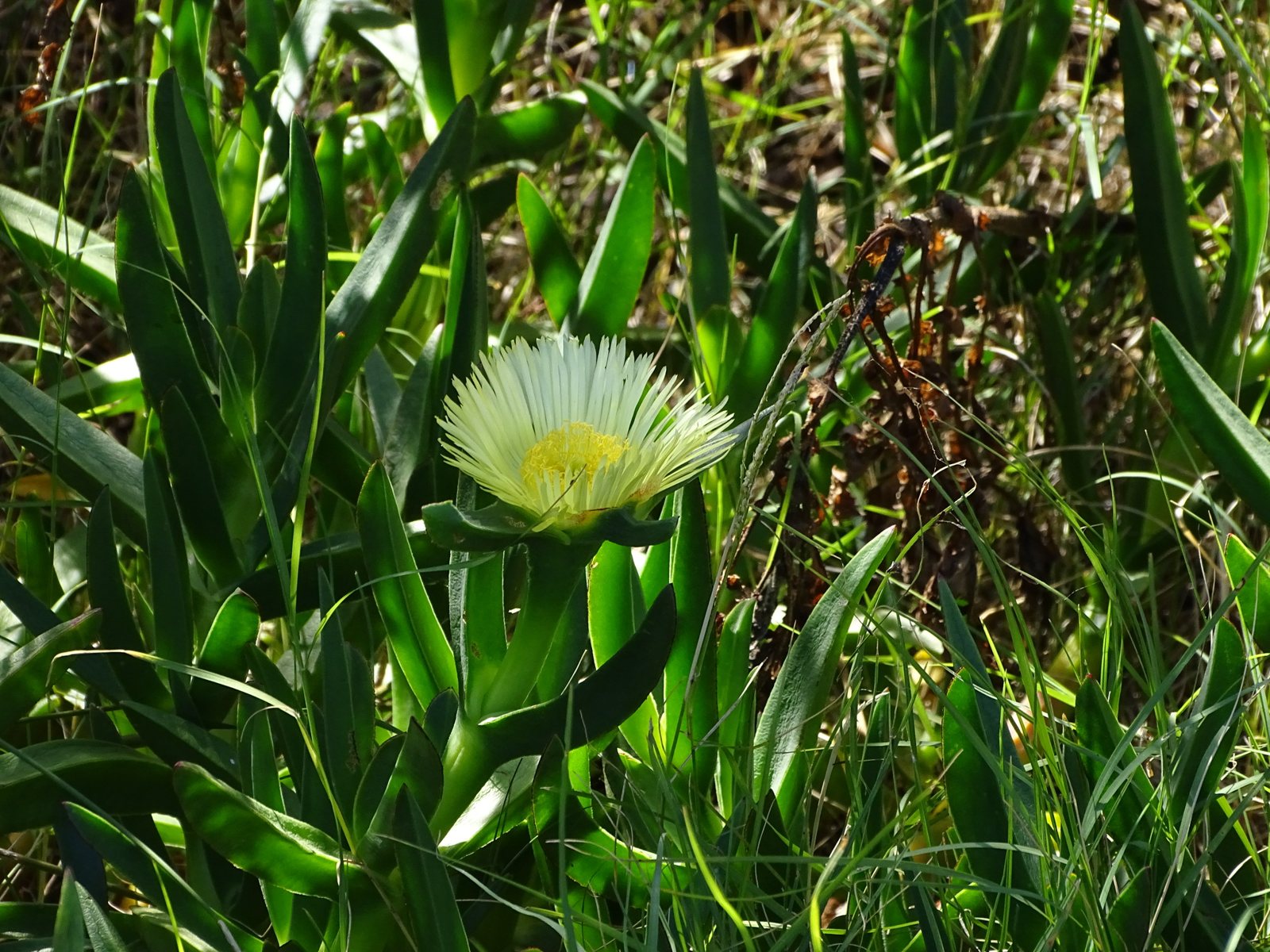
The common sour fig: an easy, fire-resistant succulent groundcover with big yellow flowers that age to pink.
What’s in the name: Carpobrotus: Greek for "edible fruit"; edulis: "edible".
“Every sweet hath its sour; every evil its good.”
— Ralph Waldo Emerson, Compensation – Ralph Waldo Emerson, Essays: First Series (1841), Project Gutenberg
Available from AVNPlants: see the availability list.
Family
Aizoaceae
Conservation status
Least Concern, SANBI Red List of South African Plants (assessed as Carpobrotus edulis (L.) L.Bolus subsp. edulis)
Natural distribution & habitat
Coastal and inland slopes, Namaqualand to the Eastern Cape; often a pioneer on disturbed ground.
Size & form
Low, trailing succulent forming dense mats, rooting at the nodes. Crowded three-angled leaves 60–130 mm long, reddening with age. Flowers 100–150 mm across.
Flowering
Mainly August to October.
Uses in landscaping
- Waterwise, wind-resistant groundcover for sand, gravel, brackish or limy soils
- Banks, rockeries, terraces and roof gardens (shallow-rooted)
- Fire-resistant barrier around buildings
Care notes
Sun, good drainage and room to spread. Not frost hardy. Summer tip cuttings 20–30 cm long root easily, planted straight out.
Wildlife value
Pollinated by many bees and beetles; tortoises eat the leaves and antelope and baboons eat the flowers.
Find out more
Facts checked against: SANBI PlantZAfrica species page 'Carpobrotus edulis'; SANBI Red List of South African Plants, Carpobrotus edulis (L.) L.Bolus subsp. edulis (assessment 2006/02/23).